We made it home about an hour earlier than expected and had no issues at customs. It helps travelling with carry-on only since you do not have to wait the hour to finally see your luggage.
Looking back at the trip, we sure did a lot and also learned an interesting fact …
What can be counted?
22 Nights away
19 Cities and Towns
56 Transports, which includes the normal like planes, trains and buses, and also a golf cart and a gondola.
355,404 Steps, which average to 16,924 per day
150 Miles walked, average of 7.14 per day
4,625 Photos kept (more were taken!)
What can NOT be counted?
New experiences in new places
All the food and drinks. It was a ‘Culinary Journey’ after all!
Meeting new people and making new friends
Best of all, celebrating a birthday with friends old and new from all over.
More interesting, what did we learn?
We ate and drank from Italy through the south of France all the way to Spain. All these countries are on the Mediterranean Sea. Conclusion we got to after we got on the scale at home: THE MEDITERRANEAN DIET DOES NOT WORK! (At some point in the trip, even my phone’s Face-ID stopped recognizing me!)
Thank you to each and everyone that made this such a great celebration trip.
“Live the life you’ll always remember!”
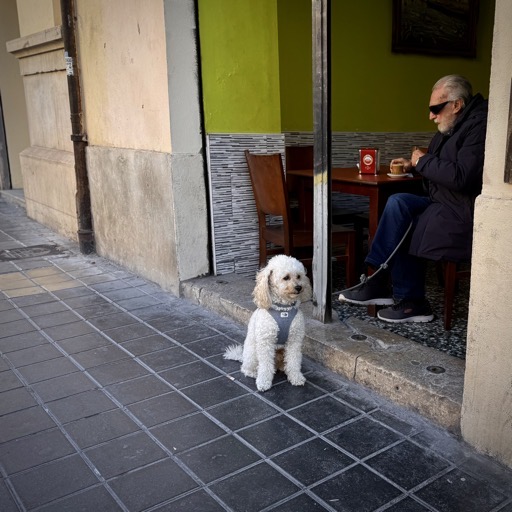
The were very happy to have the ‘pack’ all back together again.
Our last morning in Paris before we leave back to our daily grind.
We re-packed all the bags and since our plane only leaves late in the afternoon, decided to stroll Paris early in the morning, and then have a brunch with a good friend of ours to celebrate her birthday. It was a most delightful morning watching the city slowly wake up.
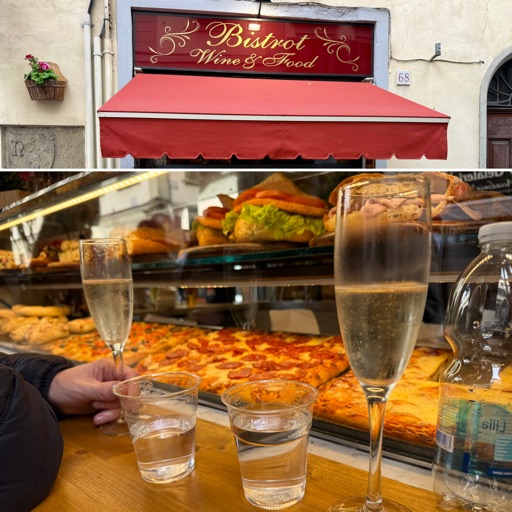
After breakfast we had a glass of wine at a small Parisienne Brasserie and decided to leave for the airport a little early since we still need to get through that process and like to relax before we board.
Little did we know… ANOTHER ADVENTURE AWAITED US!
Normally, the easiest and fastest way to the airport is by train. Very simple, you get on the train in the center of Paris, and a short time later that train drops you inside the airport which is about 20 miles away.
Not today.
The train traveled one stop only, to the main train station in Paris and there the line ended. They moved us to another train that also only traveled one stop and unloaded us all.
From here they are going to bus everybody to the airport.
Imagine, if you will, hundreds of very confused people with giant suitcases, having to walk a block or two and then getting crammed into a bus. Do not forget about the tension and stress of all these people that left for the airport at the last minute to make their flights, not anticipating all this extra time to load a bus, deal with traffic on the roads, and then unload a bus. The atmosphere was electric, not in a good way.
We left early enough so we made it through everything, relaxed in the lounge with a drink, and then boarded our plane in time. It also helped having only carry-on luggage.
Until next time, Europe!
Early morning Paris in spring.The Brasserie CatLooks like a good place to have breakfast?It was!
Church of Saint-Eustache
In the heart of Paris stands the Gothic silhouette of the Church of Saint-Eustache, It is the successor to the first parish church built in the thirteenth century, which was altered and then completely rebuilt between 1532 and 1637. From this pivotal period in the history of religious architecture, the building retains its Gothic vaults with intersecting ribs, forming a solid framework reinforced externally by buttresses. The height is impressive, reaching 33.50m under the vaults.
The originality of the building lies in its Renaissance-style decorative language: Corinthian capitals, foliage, and masks are elegantly juxtaposed with Gothic architecture. The western facade underwent rebuilding in the classical style from 1754 until the French Revolution halted construction, which left the south tower unfinished. Numerous painted and sculpted masterpieces, ranging from the fourteenth to the twenty-first century, enrich the building of the popular, lively shopping district of Les Halles.
There was a small service that started when we entered. The acoustics in that space was beautiful.
Reflections of old Paris architecture on new Paris architecture.The river SeineAnother Hector Guimard designed Art Nouveau metro stations.
Goodbye Europe, it is not Au Revoir, it is definitely À bientôt. (Or the same sentiment in all four languages we had to learn to speak over the last three weeks.)
Our day started with a nice early morning walk through the quiet streets with only the occasional firecracker going off. Last night was such a big party night in the city that there is no doubt people are sleeping in.
We learned the most fascinating facts during our tour and saw a selection of the more than three hundred Fallas. More than fascinating.
We spent the rest of the day in the city enjoying the atmosphere and watching people.
At some point, sitting in a narrow street near a corner, we regularly saw the dressed ladies followed by a band walk by and disappear again, just the echoes of the music remaining. It was such a unique experience.
The Fallas festival is a spectacular 5-day event in Valencia, Spain (March 15-19), celebrating Saint Joseph and the arrival of spring with massive satirical papier-mâché monuments called fallas. Neighborhoods display these intricate, costly structures before burning them in huge bonfires known as La Cremà on March 19th, symbolizing renewal.
It is a UNESCO Intangible Cultural Heritage of Humanity celebration that brings together community pride, artistry, and political satire, allowing for a symbolic cleansing through fire, where old energy is released to welcome spring.
The tradition dates back to the Middle Ages, when local carpenters burned old scraps of wood and debris to mark the end of winter on the feast day of their patron saint, Saint Joseph (March 19).
La Plantà (March 15-16): The act of erecting the 700+ massive fallas(monuments) and smaller ninots (puppets) overnight. Mascletà (March 1-19, 2 PM): A daily, loud, rhythmic firecracker exhibition in the Plaza del Ayuntamiento. La Ofrenda (March 17-18): An emotional flower offering to the Virgen de los Desamparados (Our Lady of the Forsaken), where a giant wooden statue of the Virgin is filled with floral bouquets by thousands of falleros. La Cremà (March 19): The grand finale, where the fallas are set on fire around midnight, starting with the children’s monuments.
Only one small piece of a falla, the ninot indultat (chosen by public vote), is saved from the fire, becoming a permanent exhibit in the city’s Fallas Museum.
The streets are filled with non-stop music, marching bands, food festivals featuring churros and buñuelos, and fireworks.
There was a lot of partying late into the night. Early morning on the way to our tour we saw a lot of people moving slow and wearing sunglasses.
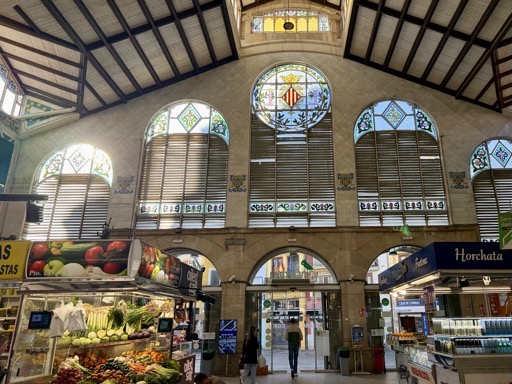
The Central Market looks like a bright and airy cathedral.
Setting up the daily fireworks, which are just noise makers with colored dust. They are really really REALLY loud.
There is still a bullring and it is still being used for that.
The origin of Fallas as told by the guide.
Originally, the farm workers build stands with lanterns on for light during the winter. At the equinox they would then burn the lantern to symbolize going into spring and the longer (and brighter) days.
Later on they would add other burnable materials for a bigger fire.
At some point they started to get creative with it and make the piles into figures, mostly satirical.
The modern Fallas are all still very themed, and invariably includes satirical elements.
They still get burned!
Every area usually creates two Fallas, the big one and a little one for the children. The themes for the child Fallas are always educational.
The detail they can get with only paper mache and wood is incredible.
Some of these are up to 24 meters tall and can cost up to €600,000. And everything gets burned to ashes on the 19th of March.
There are also more ‘avant-garde’ and experimental Fallas. This one was about gentrification and on the last day, before burning, it will be filled with little blue people that symbolize out-of-towners.
A few of them even move.
These dresses are part of the tradition. Each one is unique.
A random mini-parade.
A blacksmith shop in the middle of town.
Starting tomorrow, on the 17th of March, there will be a two-day parade with everybody dressed up. The costumed people from each neighborhood will start at their Fallas and followed by a band, walk to this square and place flowers on this statue.
The design that the flowers make is different every year and kept a secret.
More and more people in the streets every day.
Having a snack in a little street cafe and suddenly there’s music.
The ‘Miracle Square’ in Pisa was definitely worth experiencing.
The idea was the four steps of religious life: baptism, church, cemetery (burial) and the ‘stairway to heaven’.
However, since they are all so close to the water there is nothing really to support the foundations. The tower, the most concentrated mass on the smallest space, slanted first but all the other buildings are also all a little askew.
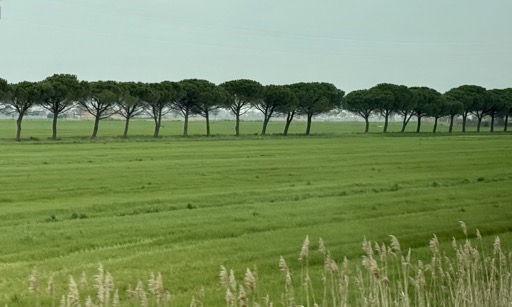
Good morning, Livorno!Umbrella Pines are everywhere.Walking into PisaOur first view through the city gate.
The Baptistery stands as one of the cardinal points of the idea of the square that was coming of age in Pisa in the XIl century; what was taking shape was a space that gave priority to the front view of the façade of the Cathedral, the axial character of which was now set off by such a meaningful building as the Baptistery, built along the same lines.
The reason for building such a fascinating as well as mysterious building was certainly the will to provide the Cathedral with a worthy addition: a Baptistery that, because of its location, size, materials and style, would be in tune with the impressive and typical building that existed before it. These might be the terms in which the holders of the local ecclesiastic and civil powers, who had expressly set up a board, the“Opera ecclesiae Sancti lohannis Baptiste”, had expressed their wishes to architect Deotisalvi, whose figure remains in the dark and can hardly be reconstructed as there are no written sources about him. The inscription “Deotisalvi magister huius operis”, “Deotisalvi is the author of this work”, found on a pillar of the Baptistery, claims authorship of the building.
According to the same source, in 1163 it was ordered that on the first day of the month every family of Pisa should pay one denaro to continue the building of the monument. This is evidence of the city’s contribution to the monument, as is also proven by the fact that the installation of the columns was organised and contributed to by the city neighbourhoods.
It is the largest Baptistery in Italy: 107.24 metres in circumference, while the wall at the bottom is two metres 63 cm wide, its height 54 metres 86 centimetres. The dome is covered in red tiles on the west side and in lead slabs on the east side.
The big cylinder is surrounded, like the Cathedral, by arcades on pillars and, like the Cathedral, it is made of white marble edged with grey. Inside, eight monolithic columns compete for height with the Cathedral, alternating with four pillars and outlining a central area that accommodates the octagonal baptismal font by Guido da Como (1246), with Nicola Pisano’s pulpit next to it (1260). A women’s gallery covered by a ringed vault looks out onto the central area with a series of large round arches. The covering is composed of a double dome, the inner one shaped like a dodecagonal truncated pyramid, the outer one in the shape of a hemispherical vault, with a smaller dome on top. It is precisely the unique architectural design of the covering that gives the Baptistery of Pisa exceptional acoustics. It can be heard every 30 minutes when the security guards perform a series of vocal intonations.
“The cathedral stands, secluded everywhere, in the vast, silent expanse of greenery enclosed by the crenellated walls of the Medieval town, that in such seclusion erected admirable monuments of its past life. In that isolation, the snow-white cathedral, visible from everywhere, looks as if it had been shaped and completed by a vast, consistent creative gesture”. (Pietro Toesca)
The importance attached by the people of Pisa to the building of the Cathedral can be read in the epigraphs that are still embedded on the façade: the tombstone of bishop Guido, who began building it, funded by the fabulous loot that the people of Pisa took from the pillage of Palermo in 1063, the tombstone of Buschetto, the first ingenious architect, in which the building is called “a temple of snow-white marble”, and the one that tells of the anti-Saracen battles of Reggio, Sardinia and Bona, in Africa.Founded in 1064 and consecrated with great pomp on September 26th 1118, the Cathedral was built in two stages, one by architect Buscheto, who created the original layout with the basilican body with four aisles and one nave, a transept with one nave and two aisles, and the dome on the cross vault, and one by Rainaldo, who extended the building and the façade.
The building was not finally completed until the last quar ter of the XII century, when Bonanno’s bronze leaves were placed on the central door. This famous masterpiece was lost, along with other important works of art, in the devastating fire of 1595.
Inside, the nave is edged by two rows of monolithic columns made of granite from the Isle of Elba, flanked by four aisles separated by smaller colonnades with large women’s galleries on top, covered by cross vaults and looking out onto the nave through some double-lancet and four-lancet windows.
The nave is covered by a wooden coffered ceiling that in the XVII century replaced the original exposed trusses.
Of the rich and sumptuous decoration prior to the fire, remain the mosaics on the apsidal conch – where Cimabue made the figure of Saint John the Evangelist (1302 ca.) – the pulpit (1302-1310) by Giovanni Pisano, the dismembered sepulchral monument to Emperor Henry VII (1315), which used to be at the centre of the apse, and important examples of painting and wooden inlay of the Renaissance period.
The Cemetery is the last monument on Piazza del Duomo, its long marble wall flanking the northern boundary and completing its shape. It was founded in 1277 to accommodate the Roman sarcophagi that until then were scattered all around the Cathedral and were reused to bury local noblemen. This is how one of the oldest Christian Medieval architectures for the devotion of the dead came into being.
During the fourteenth century, as the construction took shape, the inner walls were embellished by wonderful frescoes about Life and Death, created by the two great artists of the time, Francesco Traini and Bonamico Buffalmacco, who seem to stage the sermons declaimed in town by the Dominican Cavalca or the frightening views of Dante’s Comedy; reference to it is most evident in the Triumph of Death and in the Last Judgement painted by Buffalmacco, who is also known as the character of some of Boccaccio’s stories. The cycle of frescoes goes on well into the fourteenth century with the Stories of Pisan Saints by Andrea Bonaiuti, Antonio Veneziano and Spinello Aretino and the Stories of the Ancient Testament, started by Taddeo Gaddi and Piero di Puccio and finished in the mid-15th century by the Florentine Benozzo Gozzoli, along the northern wall.
Since the sixteenth century, the Cemetery has sheltered the sepulchres of the most prestigious lecturers of the local University and the members of the Medici family, who ruled over the city at that time and are also hinted at by the characters of the Biblical scenes frescoed on the shorter walls.
The monument was to become the Pantheon of local mem-ories: not only of the local people or families but also of the glorious classical and Medieval past of the city. The building began to be used as a museum, its walls engraved with Roman epigraphs and the sarcophagi relocated to the corridors, acting now as valuables documents of history and art.
The use of the building as a museum established itself in the early nineteenth century when the Cemetery became one of Europe’s first public museums. In the years in which Napoleon decreed that many works of art should be taken away from the churches and taken to France, Carlo Lasinio, appointed Curator of the Cemetery by Maria Luisa, Queen of Etruria, collected amidst its frescoed walls the sculptures and paintings that were in the suppressed churches and convents of the city. Other works came from the Cathedral and the Baptistery, along with remains from the local archaeological sites and the antiques markets. In the meantime, commemorative and funerary monuments dedicated to the city notables continued to be built in the corridors that were renamed galleries.
Apart from its extremely famous inclination that really seems to defy the laws of statics, the Tower of the Cathedral is a very unusual building and one of a kind, because of the high historical and artistic value of its forms and because of its peculiar location, within that vast and equally unique area that is the Piazza dei Miracoli. The building is located far from the Cathedral, between the apsidal area and the southeastern section of the transept of the Cathedral. This is an unusual location – usually, a tower would be erected near the façade or along one side of the church – although this is not the only case, as it can be found in other complexes in town and in other Italian buildings. The current building, the result of a time-consuming construction work that was restored several times over the centuries, mostly to reduce the risk that it might collapse as a consequence of its remarkable inclination, is composed of a cylindrical stone body surrounded by open galleries with arcades and pillars resting on a bottom shaft, with the belfry on top. The central body is composed of a hollow cylinder with an outer facing of shaped pillars in white and grey San Giuliano limestone, an interior facing, also made of textured verrucana stone, and a ring-shaped stone area in between. This stone area accommodates a winding staircase with 293 steps leading up to the sixth open gallery, where the inner shaft is closed by a vault with a central hole to let light in, providing access to the belfry on top and, in the lower mezzanine floors, to the open galleries. The six open galleries resting on the bottom shafts, with this one and the belfry, divide the tower into eight segments that are called orders. The lower one is enriched by a round of blind arcades placed on half columns that include, under the arcade, a diamond-shaped compass inlaid with polychrome marble, with a raised rosette in the middle. The solid walls interrupted by the openings of some narrow single-lancet windows and, westwards, by the only entrance door: a rectangular area framed by a lintel. Above the lintel, a crescent-shaped arch with an inlaid archivolt rests on two capitals as a continuation of the jambs, forming a shrine containing the bust of a 14th-century Virgin with Child. On the sides of the door, some friezes decorated with animals and monstrous figures and the unusual figures of some ships (the Port of Pisa?) frame the commemorative epigraph of the foundation of the building.
We left Venice very early to make sure we do not miss our train again.
Florence was an intense delight. We saw David, the only stop we planned, and ended up adding on Ponte Vechhio as well as, of course, a Wine Window!
Good bye, Venezia!Having Prosecco while waiting for our timed tickets.
“Nor has there ever been seen a pose so fluent, or a gracefulness equal to this, or feet, hands and head so well related to each other with quality, skill and design”. With these words Giorgio Vasari attempts to define the reasons behind the marvel that the vision of David provokes in the observer. He continues by stating that the statue so far surpasses both in beauty and technique ancient and modern statuary that one needn’t bother seeing other works in sculpture.
At the end of 1501, Michelangelo obtained the permission of the Opera del Duomo to work a block of marble which had been abandoned in the courtyard of the Cathedral of Florence for the creation of the figure of the young hero, subsequently placed in front of Palazzo Vecchio in Piazza Signoria.
It has always been a subject of debate among scholars whether David is represented before or after his victory over Goliath. His sling is also barely visible as though to emphasize how David owed his victory not to brutal force, but to his intellect and to his innocence. As soon as it was placed in front of Palazzo Vecchio, the statue became a symbol of liberty and of civic pride for the Florentine Republic. Surrounded by hostile enemies, the city identified itself with the young hero who, with the help of God, had defeated a much more powerful foe.
In 1873, Michelangelo’s statue was brought here to the Tribune of the Galleria, built expressly for it and, only in 1908, was it substituted in Piazza Signoria by the marble copy still there today. The bronze copy found in Piazzale Michelangelo overlooking Florence was done in 1866.
Our first pizza in Italy ever!Found a Wine Window!Onwards to Roma!
Venice exist only on its own terms, and does not care to compromise.
It is a city full of surprises tucked away in narrow alleys and seemingly dead ends. It is a incomprehensible maze between ancient looming structures crisscrossed with canals. A glimpse of something green behind a closed gate might indicate a very rare garden, usually in front of a palace. In the plazas you are blessed with a momentary reveal of the sky.
And, underneath all these buildings, are only wooden pilons driven into the ocean sand, and water. On top of this is built a place of wonder that would not even nature claim it.
It is pure joy to simply give yourself over to it and get lost in the magic.
First random stop for a glass of wine. A delightfully no-frills (ancient) little pizza place.
Another stop for wine. The place was so tiny you could barely get 6 people in the whole wine bar.
As Pieter yet again randomly turned into another dark and barely lit alley:
Kenn: “We are going to die!”
Pieter: “Seriously, have I ever gotten you killed?”
Gondolas in front of the Rialto bridge.
We took to heart the ‘rule’ that states: for the best meal, get away from the tourist areas and and find a place where the locals eat.
Let me give you an example: If you set a 5:30am alarm to make your 7:30am train, but you forgot to check the ‘weekdays only’ setting, guess what happens?
Since you did not realize it is Sunday, your alarm will not go off and you will sleep exhaustedly until 7:32.
And this, kids, is where our word of the day, pivot, comes in.
After a search across all possible train providers you will come to the realization that there is no available rail option that will get you to Venice in the same day.
Now what do you do to get to Venice? Can you all say together: pivot!
A more generic search reveals a flight that leaves at noon!
We pivoted.
Even though the cons of a good night’s sleep includes no train ride and a scorched credit card for last minute tickets, there are pros as well: a much shorter travel time, and a lot more time in Venice!